

Psychological Thrillers vs Monster Movies: When most people think of horror, they picture fanged creatures, masked killers, or the kind of slimy monsters that jump out from the dark. But the truth is, the scariest things in movies aren’t the beasts lurking under the bed, they’re the thoughts inside our own minds.
Psychological thrillers take fear and turn it inward. Instead of chasing you through haunted houses, they quietly crawl under your skin. They twist perception, question morality, and make you doubt what’s real. And that’s what makes them terrifying.
Unlike monster movies, psychological thrillers don’t give you something obvious to run from. They make you face something worse yourself.
Let’s break down why psychological thrillers can be far more frightening than traditional monster horror, and why they stay with you long after the credits roll.
1. The Monster Is Human – and That’s the Problem
One of the main reasons psychological thrillers hit harder is that they show us monsters that could actually exist.
Films like Se7en (1995) and The Silence of the Lambs (1991) don’t rely on supernatural creatures. Their villains John Doe and Hannibal Lecter are terrifying precisely because they feel real. They think, plan, manipulate, and smile. There’s no mask to hide behind, no curse to break.
Hannibal Lecter doesn’t need claws or fangs. His weapon is his mind and his ability to get inside yours. Watching him dissect his victims emotionally before he does it physically is what truly chills the soul.
That realism is what makes psychological thrillers so powerful. You can turn off the lights to escape a ghost, but how do you escape another person or worse, your own thoughts?
2. They Play With Reality Until You Don’t Know What’s Real
Monster movies show you what to fear. Psychological thrillers make you feel fear without showing you anything at all.
Think of Black Swan (2010) or Shutter Island (2010). Both blur the line between sanity and delusion. You’re never quite sure what’s happening, or if what you’re seeing is real. That confusion isn’t just a trick, it’s part of the fear.
In Shutter Island, Leonardo DiCaprio’s character spirals deeper into paranoia as the truth unfolds. Every frame feels unstable, every sound suspicious. By the time you reach the ending, you realize the scariest thing isn’t the asylum or the storm, it’s the human mind unraveling in real time.
That uncertainty keeps viewers off balance. You’re not screaming in shock, you’re shivering in unease.
3. Fear of Losing Control Hits Harder Than Any Jump Scare
Physical monsters attack from the outside; psychological thrillers attack from within.
Movies like Gone Girl (2014) or Memento (2000) aren’t about demons or murderers jumping out of the dark, they’re about people losing control of their lives, their memories, their sense of truth.
In Memento, the main character can’t form new memories, forcing both him and the audience to question every event. Each scene becomes a trap, and you realize that losing control of your own mind might be the most horrifying thing of all.
That’s what makes these films different; you can’t fight them off. You can’t shoot or stab your fears. The real horror lies in your mind, your choices, your guilt.
4. The Tension Never Ends – It Lingers
Monsters can be defeated. Psychological tension can’t.
In The Sixth Sense (1999), the big twist changes everything you thought you knew but it’s the emotional weight that stays with you. The same goes for Hereditary (2018), which begins as a family drama and slowly unravels into psychological chaos before diving into horror.
Unlike creature features, where the monster dies and the credits roll, thrillers leave you questioning everything. You keep replaying scenes in your mind, noticing things you missed, realizing how the story manipulated your emotions from start to finish.
That’s not an accident. It’s intentional. A good psychological thriller doesn’t just end; it echoes.
5. They Expose Real – World Fears We Don’t Like to Admit
It’s easy to laugh off a monster because you know it’s fiction. But the themes behind psychological thrillers hit closer to home obsession, identity, guilt, manipulation, trauma.
Movies like Get Out (2017) and Joker (2019) tackle social and mental realities we actually live with. Get Out uses psychological horror to explore racism and control, while Joker dives deep into isolation and societal breakdown.
These films make you think about human nature and how far someone can fall when pushed too hard. That’s the kind of fear you can’t shrug off after the credits. It’s raw, relevant, and painfully real.
6. Unpredictability Is the New Scare Tactic
In traditional horror, you know what to expect: a jump scare, a scream, a sudden attack. Psychological thrillers break that rhythm.
Take Fight Club (1999). At first, it seems like a story about rebellion and chaos, until the shocking twist redefines everything. You weren’t watching a fight against society, you were watching a man fight himself.
That unpredictability makes your brain work overtime. You’re constantly guessing, questioning, and doubting and that’s a special kind of anxiety monster movies rarely deliver.
When you don’t know who to trust or even what’s real you’re no longer just watching the story. You’re trapped inside it.
7. Sound, Silence, and Subtlety Make Everything Worse
Monster movies often rely on loud soundtracks and jump scares. Psychological thrillers, on the other hand, use silence as their weapon.
In Prisoners (2013), the tension builds slowly, the rain, the clock ticking, the quiet moments between conversations. You’re waiting for something to explode, but it never does in the way you expect. That kind of restraint creates real suspense.
Directors like David Fincher and Denis Villeneuve understand that fear isn’t about volume it’s about precision. A look, a pause, or a quiet confession can make your skin crawl more than a scream ever could.
8. The Audience Becomes Part of the Fear
Perhaps the most chilling thing about psychological thrillers is how they make you part of the experiment.
In Gone Girl, viewers find themselves switching sides one moment you pity Amy, the next you fear her. That manipulation is the point. You realize you’re not just watching the story unfold; you’re being psychologically played, too.
Films like The Machinist (2004) and American Psycho (2000) use this same effect. You start by trying to understand the characters then you start to wonder if you’re any different from them.
That moral discomfort is what makes these films unforgettable. They’re not trying to scare you for fun, they’re trying to make you question yourself.
9. Great Psychological Thrillers Are Character Studies Disguised as Horror
At their core, these films aren’t about what happens, they’re about who it happens to.
In Taxi Driver (1976), the horror isn’t in the violence but in watching a lonely man’s slow mental decay. Nightcrawler (2014) does the same with ambition and ethics, showing how a desperate cameraman crosses one moral line after another.
These stories force us to look at how ordinary people can become something monstrous. That’s more chilling than any supernatural creature because we realize it could be anyone, even us.
10. The Fear That Stays After the Screen Fades
The difference between a monster movie and a psychological thriller is simple: one scares you for a night, the other stays with you for a lifetime.
Movies like Se7en, The Shining, or Gone Girl don’t make you scream, they make you think. You walk away uneasy, asking questions, replaying scenes in your head. That’s not an accident. It’s the mark of a genre that knows fear isn’t just about what you see, it’s about what you feel.
Psychological thrillers understand that the human mind is the most dangerous place of all. It doesn’t need claws or shadows to haunt you, it just needs doubt.
Final Thoughts on Psychological Thrillers vs Monster Movies
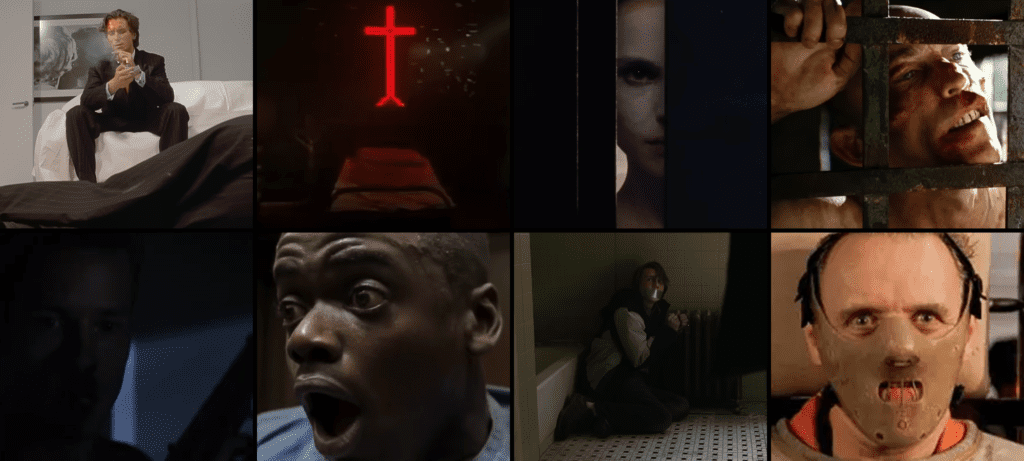
While monster movies will always have their place, the true evolution of fear in cinema lies in the psychological. These stories strip away the supernatural and force us to confront what’s real: our flaws, our obsessions, our fragile sense of control.
A creature in the dark might make you jump. But a psychological thriller makes you question yourself. And that’s a fear no monster can match.
So next time you’re in the mood for something scary, skip the fangs and find a film that looks inward instead of outward. You might not scream as loud but you’ll definitely sleep a little less soundly.